
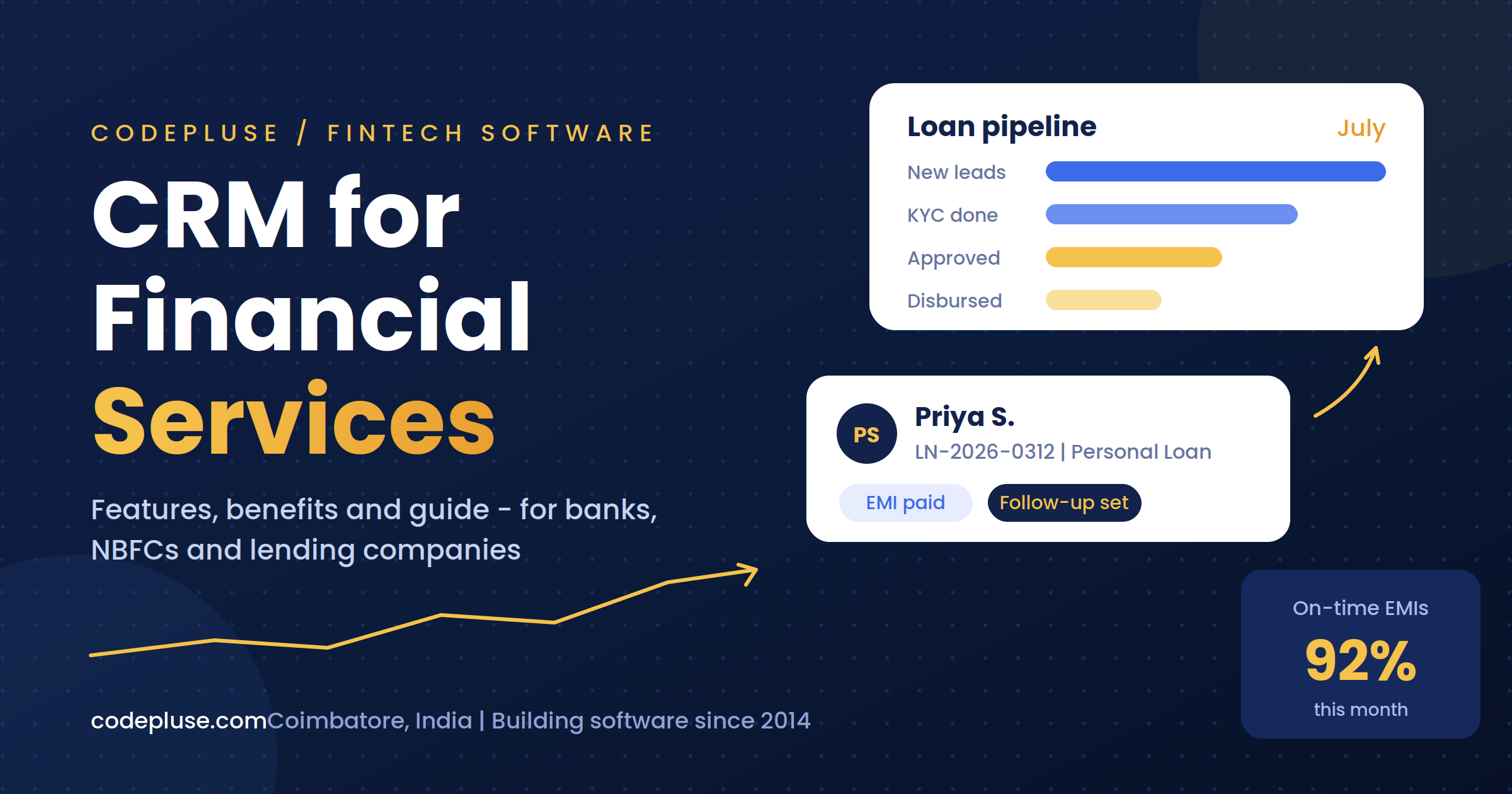
CRM for Financial Services: Features, Benefits and Guide
Managing customer relationships in finance is not like managing them in any other industry. Every customer has loans, payments, documents, and compliance records attached to them. A missed follow-up is not just a lost sale. It can mean a missed EMI, an unhappy borrower, or a compliance gap.
That is why a CRM for financial services exists. It is built for how banks, NBFCs, microfinance firms, and lending companies actually work.
In this guide, we will explain what a financial services CRM is, the features that matter, the benefits you can expect, and how to choose the right one for your business.
What Is a CRM for Financial Services?
A CRM for financial services is software that helps banks, NBFCs, and lending companies manage customer data, track loans and payments, automate follow-ups, and stay compliant, all from one place. Unlike a general CRM, it connects customer records directly with loan accounts, EMI schedules, and collection workflows.
Think of it as a single source of truth for every customer. When a borrower calls your office in Coimbatore or applies online from anywhere in India, your team sees their full history in seconds. No digging through spreadsheets. No asking the customer to repeat details.
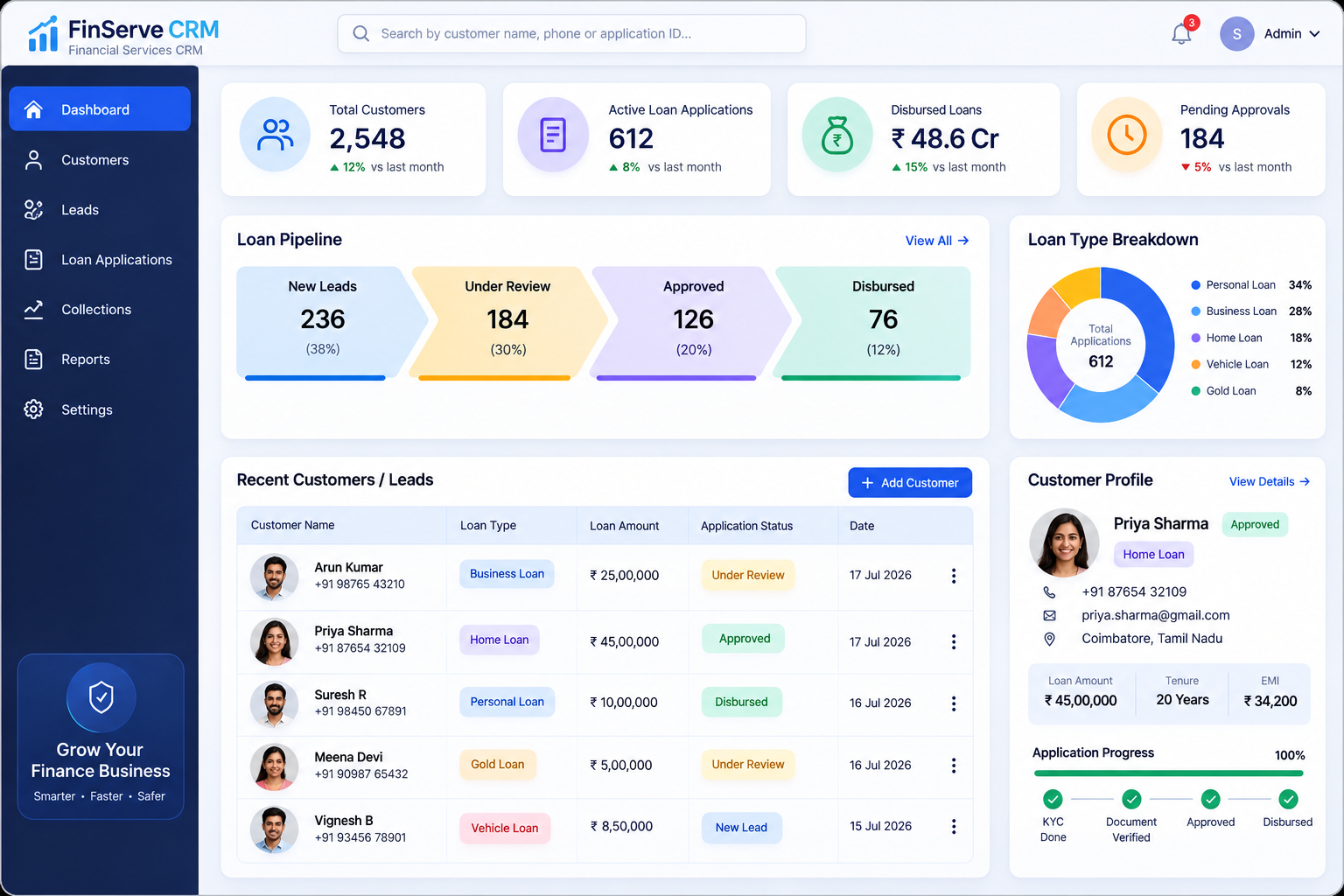
A general CRM like a sales tool can store contacts and deals. But it does not understand loan cycles, KYC documents, or overdue buckets. A financial CRM does.
Why General CRMs Fall Short for Finance Companies
Many finance companies start with a general CRM and hit the same walls:
- No loan account view. Sales tools track deals, not EMI schedules or outstanding balances.
- No collections workflow. There is no way to sort borrowers by days past due or assign field visits.
- Weak compliance support. KYC documents, consent records, and audit trails need special handling.
- Poor integration with lending systems. Your CRM and your loan software end up as two separate islands.
The result is double data entry, missed follow-ups, and teams working from outdated information. A purpose-built CRM for the financial industry solves these problems because finance workflows are built into its core.
Key Features of a Financial Services CRM
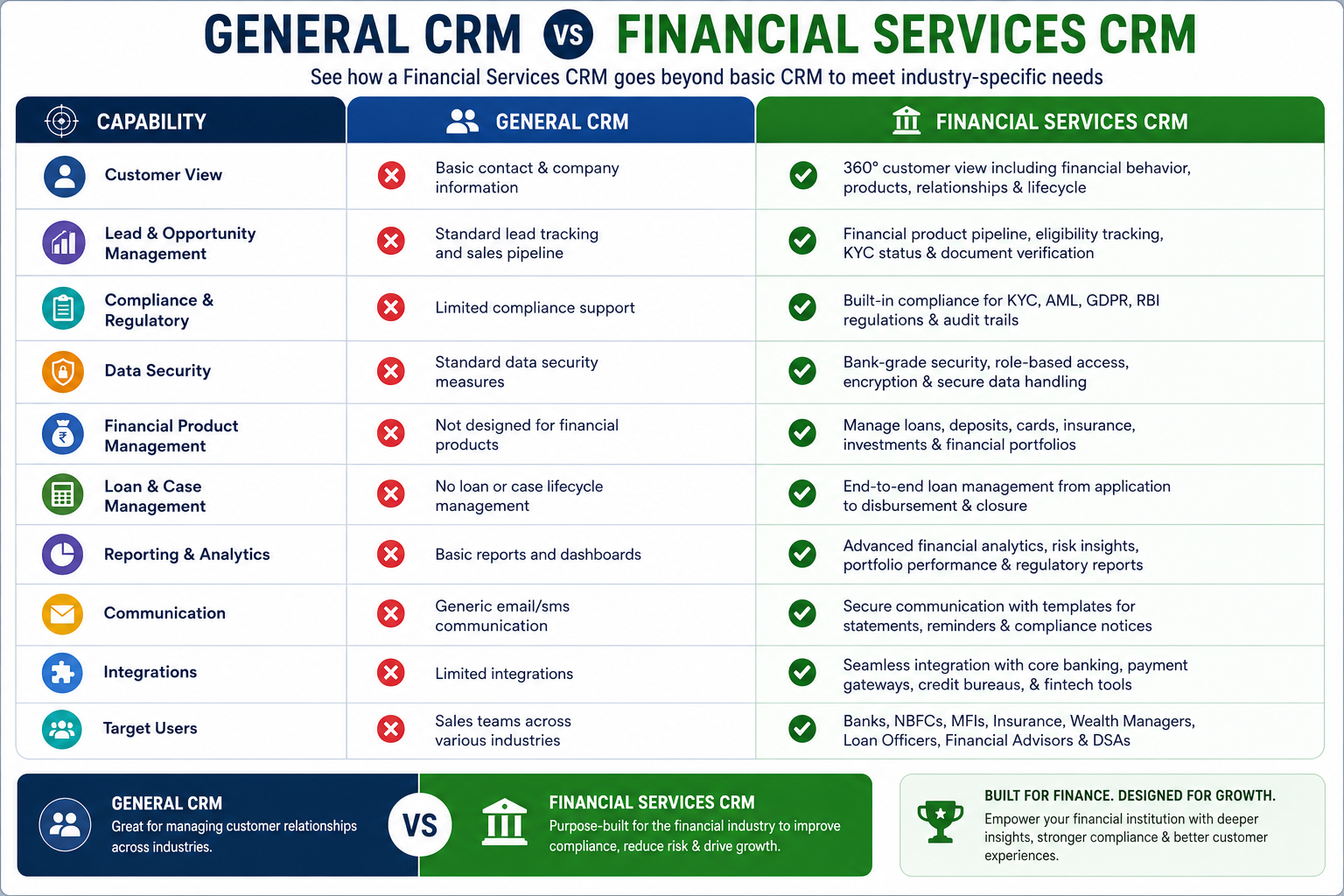
Here are the features that separate a true financial CRM from a repackaged sales tool.
1. 360-Degree Customer View
Each profile pulls together the borrower's basic details, KYC status, running loans, repayment record, call notes, and open requests into a single view. When your staff can see everything at once, they reply to queries in seconds and catch upsell moments, such as suggesting a gold loan the week a customer clears their personal loan.
2. Lead and Loan Pipeline Management
Track every lead from first enquiry to disbursed loan. Assign leads to agents, set follow-up reminders, and see exactly where each application is stuck. This pairs naturally with a loan origination system that handles the application and approval side.
3. Automated Follow-Ups and Reminders
Send EMI reminders, birthday wishes, and renewal alerts by SMS, WhatsApp, and email automatically. Automation is where teams see the biggest time savings. Codepluse clients report up to 90 percent reduction in manual work after automating routine follow-ups.
4. Collections and Recovery Management
Sort overdue accounts by DPD buckets, assign them to collection agents, and log every visit and promise to pay. A CRM that talks to your debt collections software keeps recovery teams and customer teams on the same page.
5. KYC and Document Management
Store Aadhaar, PAN, and other KYC documents against each customer with expiry alerts and access controls. This keeps your compliance records in order and takes the stress out of audit time.
6. Integration with Core Lending Systems
Your CRM should connect with your loan management system, digital banking platform, and payment APIs so data flows automatically. When a payment is received, the CRM should know without anyone typing it in.
7. Reports and Dashboards
See lead conversion rates, agent performance, collection efficiency, and portfolio health in real time. Good reporting turns your CRM from a data store into a decision tool.
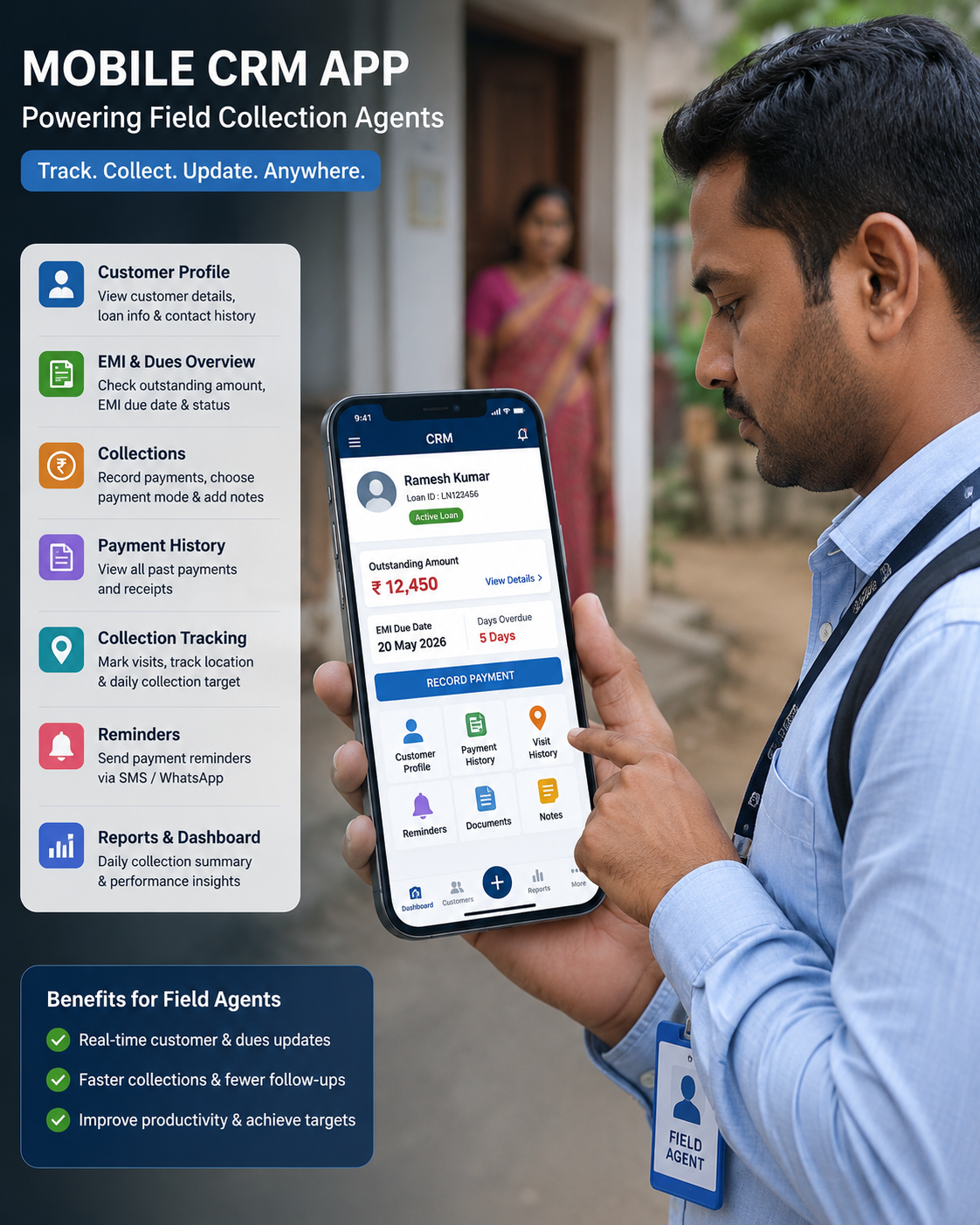
8. Mobile Access for Field Teams
Field agents in Tier 2 and Tier 3 towns across Tamil Nadu and India need mobile access to update visits, collect payments, and capture documents on the spot, even in low-network areas.
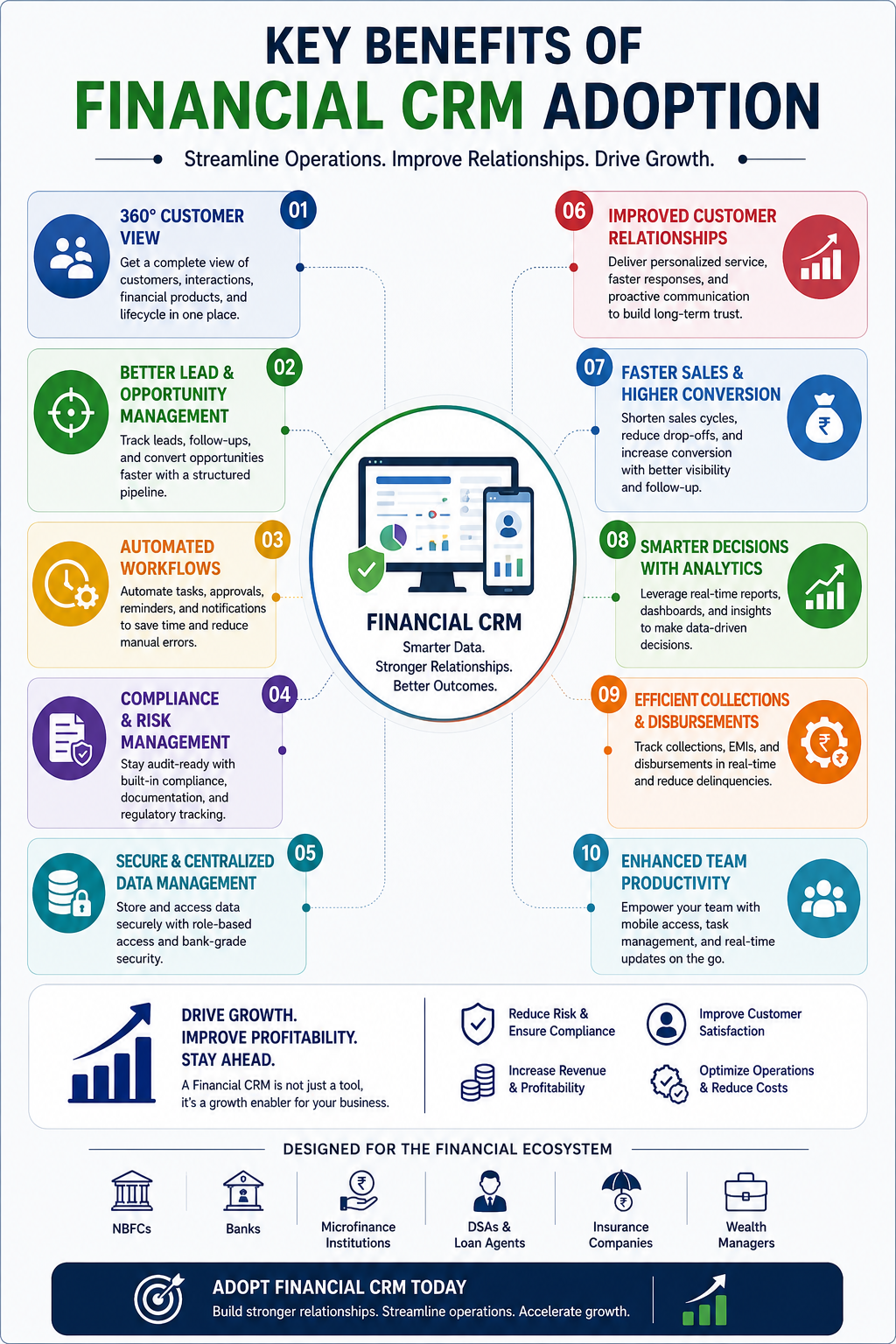
Benefits of Using a CRM for Financial Services
What does a financial services CRM actually do for your business? The main benefits are faster loan processing, fewer missed follow-ups, better collections, stronger compliance, and higher customer retention. Most firms see results within the first two to three months as teams stop juggling spreadsheets and start working from one system.
Let us break these down.
Faster Response Times
When customer data is in one place, your team responds to enquiries in minutes instead of hours. Speed matters in lending. In most cases, the lender who calls back first is the one who gets the business.
Higher Lead Conversion
Automated follow-ups mean no lead goes cold because someone forgot to call back. Firms using structured pipelines typically convert more enquiries into disbursed loans.
Better Collection Efficiency
With DPD-wise tracking and automated reminders, more EMIs come in on time and recovery teams focus on the accounts that need attention most.
Stronger Compliance and Audit Readiness
Every interaction, consent, and document is logged. When auditors or regulators ask for records, you pull them up in minutes.
Improved Customer Retention
Finance is a repeat business. A customer who took a two-wheeler loan today may need a business loan next year. A CRM helps you stay in touch and win that next loan before a competitor does.
Lower Operating Costs
Less manual data entry, fewer errors, and automated communication mean your team handles more customers without adding headcount.
Who Needs a Financial Services CRM?
- NBFCs managing personal, business, or vehicle loans - often alongside an NBFC management system
- Gold loan companies with branch and field operations
- Microfinance institutions handling group and individual lending
- Chit fund companies tracking members and auctions
- Housing finance companies with long loan cycles
- Fintech startups building digital-first lending journeys
- Cooperative societies and small banks modernizing customer service
If your team manages customer relationships in spreadsheets or across disconnected tools, a CRM will likely pay for itself quickly.
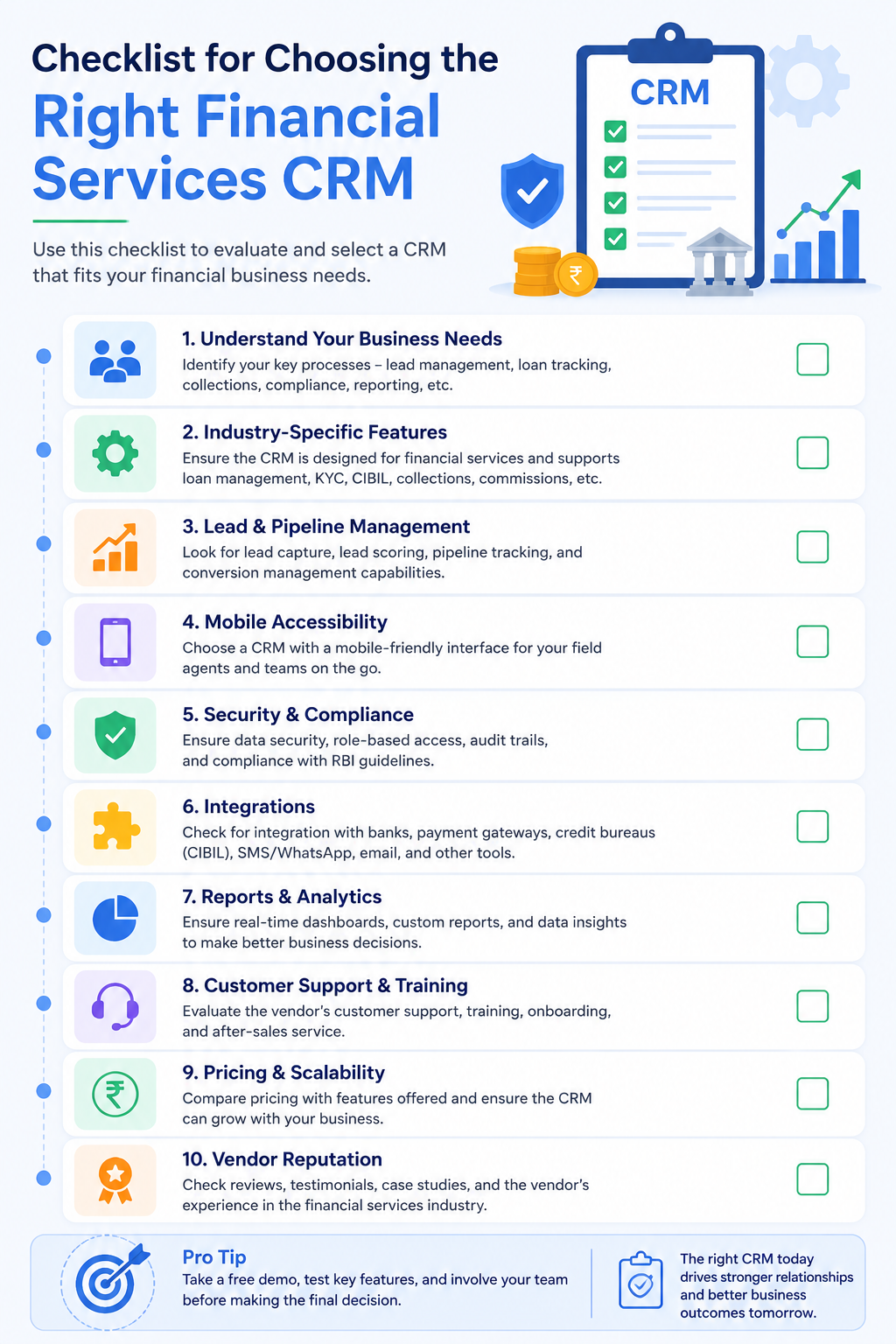
How to Choose the Right CRM for Your Finance Business
Follow these six steps:
Cloud vs On-Premise CRM: Which Is Better?
For most finance companies, a cloud CRM is better because it costs less upfront, updates automatically, and lets teams work from anywhere. On-premise suits firms with strict internal data policies or existing server infrastructure. Many Indian NBFCs now choose cloud systems hosted in Indian data centers to balance flexibility and data localization.
Here is a quick comparison:
| Factor | Cloud CRM | On-Premise CRM |
| Upfront cost | Low | High |
| Maintenance | Vendor handles it | Your IT team handles it |
| Access | Anywhere with internet | Office network |
| Updates | Automatic | Manual |
| Best for | Most NBFCs and lenders | Firms with strict internal IT policies |
How Codepluse Helps Finance Companies with CRM
Codepluse is a Coimbatore-based software company serving finance businesses since 2014. With a team of 80+ developers and 133+ active finance software clients across India, we build and implement CRM solutions designed for the way Indian NBFCs, gold loan firms, and lending companies work.
Our CRM for the financial industry connects with our loan management, digital banking, and collections products, so your customer data, loan data, and payment data live in one connected system. Clients report up to 90 percent reduction in manual work after moving from spreadsheets to our platform.
Whether you run a single-branch finance firm in Tamil Nadu or a multi-state NBFC, our team can customize the CRM around your workflows through our custom software development services.
Frequently Asked Questions
What is a CRM in financial services?
A CRM in financial services is software that manages customer data, loans, follow-ups, and communication for banks, NBFCs, and lending firms. It gives teams a complete view of each customer, automates reminders, and connects with loan and payment systems to reduce manual work.
How is a financial CRM different from a normal CRM?
A financial CRM understands loans, EMIs, KYC documents, and collections. A normal CRM only tracks contacts and sales deals. Financial CRMs also include compliance features like audit trails and document management that general tools lack.
What features should I look for in a CRM for NBFC?
Look for a 360-degree customer view, loan pipeline tracking, DPD-wise collections management, KYC document storage, automated SMS and WhatsApp reminders, mobile access for field agents, and integration with your loan management system.
How much does a financial services CRM cost in India?
Pricing depends on the number of users, features, and customization needs. Cloud CRMs usually charge per user per month, while customized systems are priced by project scope. Contact the vendor for a quote based on your team size and workflows.
Can a CRM help with loan collections?
Yes. A financial CRM sorts overdue accounts by days past due, assigns them to agents, sends automated payment reminders, and logs every visit and promise to pay. This improves on-time collections and reduces recovery costs.
Is a cloud CRM safe for financial data?
Yes, when the vendor uses encryption, role-based access, and hosting in Indian data centers. Before signing up, check how the vendor handles security, where your data will be stored, and how often backups are taken.
Can a CRM integrate with my existing loan software?
Most modern CRMs integrate through APIs. Before buying, confirm the CRM connects with your loan management system, payment gateways, and messaging platforms so data flows automatically between systems.
How long does CRM implementation take?
A standard cloud CRM setup takes two to four weeks. Customized implementations with integrations and data migration usually take one to three months, depending on how much historical data and how many workflows are involved.
Do small finance companies need a CRM?
Yes. Small firms often benefit the most because a CRM replaces scattered spreadsheets and notebooks. Even a five-person team saves hours every week through automated reminders and a single customer database.
What is a 360-degree customer view?
It is a single screen showing everything about one customer: personal details, KYC status, active loans, payment history, past calls, and pending requests. With this view, staff can handle customer questions quickly and spot chances to offer another suitable product.
Can field agents use a CRM on mobile?
Yes. Good financial CRMs offer mobile apps where field agents can update visit notes, collect payments, capture documents, and check customer details on the go, even in areas with weak network coverage.
Does a CRM help with compliance?
Yes. A financial CRM logs every customer interaction, stores KYC documents with access controls, and maintains audit trails. This makes it easier to respond to audits and follow data handling requirements.
Which industries use financial services CRM?
NBFCs, banks, gold loan companies, microfinance institutions, chit funds, housing finance companies, fintech startups, and cooperative societies all use financial CRMs to manage customers, loans, and collections.
How do I migrate my existing customer data to a new CRM?
Most vendors provide data migration support. Your existing data from spreadsheets or old software is cleaned, mapped to the new system fields, and imported. Do a trial migration first and cross-check a sample of records before you switch fully to the new system.